Monthly Archives: January 2024

A Fun Valentine’s Day Activity

This Valentine’s Day activity is an opportunity for students to tell each other how they are special.  At the end of the activity, each student will have a You Are Special Because  . . . heart that has been signed by their classmates with comments about what makes them special.

  • All students can take part in this activity. It would be nice for all students to have Valentine’s Day treats to share, but that may not be possible. The teacher could provide additional treats.

Preparation Before the Activity
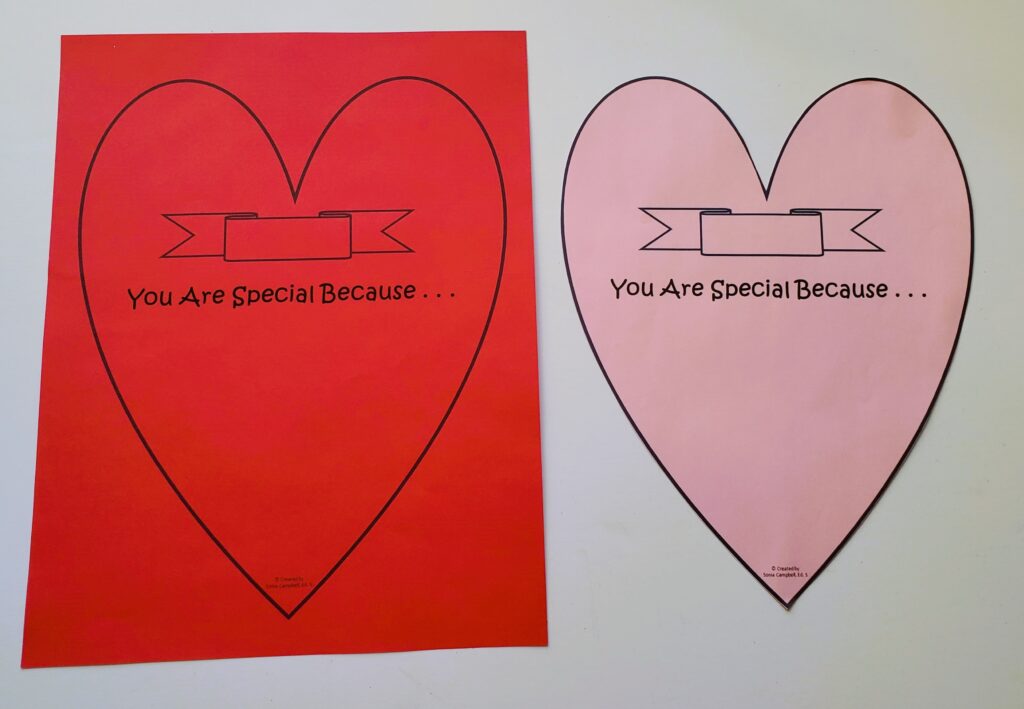
You Are Special Because . . . template.

Print and cut out a class set of You Are Special Because . . . heart. (The free heart PDF is below.)

The cut-out hearts are taped on to students’ desks/tables and the teacher’s desk.

It is suggested that the teacher prepares a small treat for each student.


A Read Aloud Before the Activity
I recommend reading Somebody Loves You, Mr. Hatch by Eileen Spinelli to the class to get students thinking about how we can make each other feel special and why this is important. Here are some questions that can be shared with the students before the reading. The questions will help them focus in on the text.

1. How is Mr. Hatch at the beginning of the story? (Mr. Hatch is lonely.)

2. What happens to make him share chocolates from the heart-shaped box? (Mr. Hatch gets a heart-shaped box that has a card that says, “Somebody loves you.” He laughs, dances, and claps his hands. He is happy.)

3. How does Mr. Hatch help Mr. Smith and Mr. Todd? (Mr. Hatch watches Mr. Smith’s stand so that he can go to the doctor. Mr. Hatch looks for Mr. Todd’s little girl.)

4. What causes Mr. Hatch to go back to being alone? (Mr. Hatch finds out that the Valentine’s heart-shaped box and note was not meant for him.)

5. How does everyone react? (Everyone gathers outside Mr. Hatch’s house to show that “Everyone loves Mr. Hatch.”)

Class Discussion

How does Mr. Hatch change from the beginning to the end of the story?

In the beginning, Mr. Hatch is very lonely. When he receives a heart-shaped box with a note that says, “Somebody loves you.” He becomes friendly to everyone. When he finds out that the box was delivered to the wrong address, he goes back to being alone. However, in the end, everyone shows him that he is loved and that he is special. He embraces their love.

If you are not able to get a hard copy of Somebody Loves You, Mr. Hatch, you can access it at Storyline Online https://storylineonline.net/books/somebody-loves-you-mr-hatch/

Next, have a specific time for students to pass out their Valentine’s Day treats.
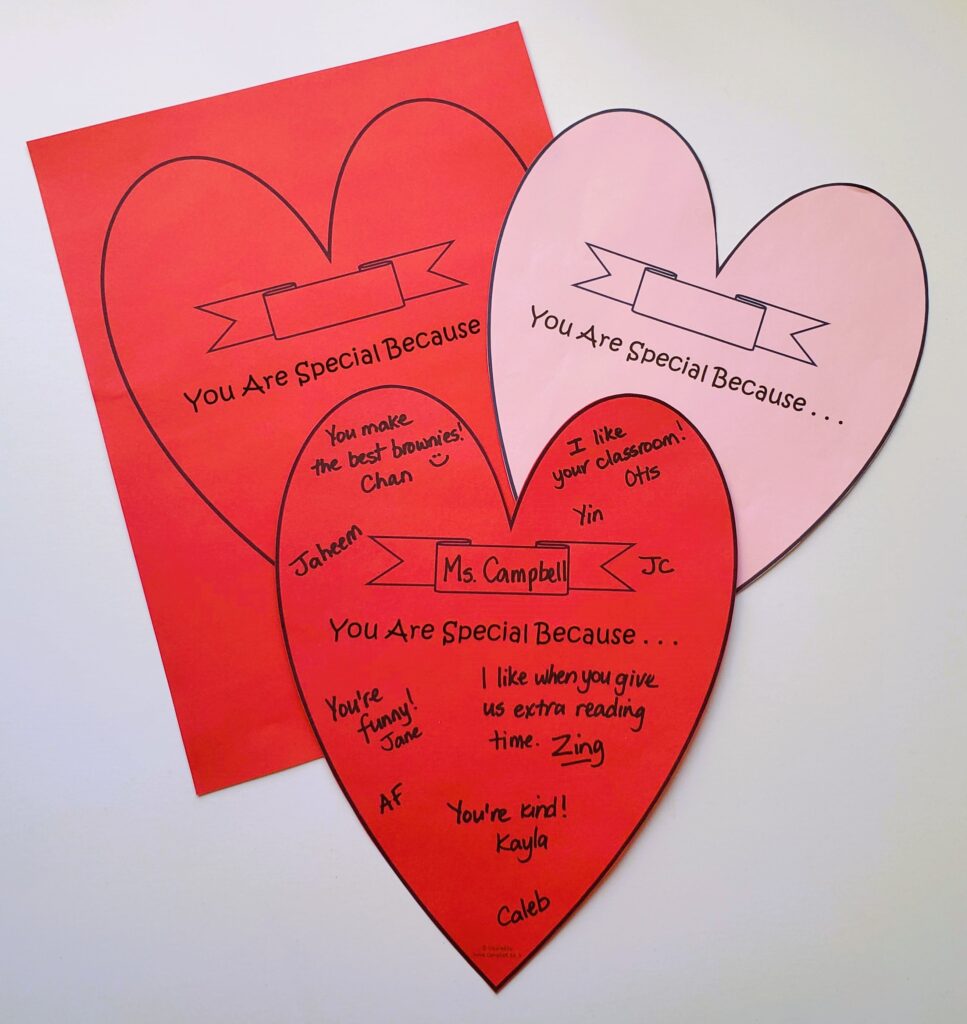
Example of how the You Are Special Because . . . template can be filled in.

Directions to students

  • Students are to write a nice comment about why they think that student is special.
  • If a student cannot think of something to say but wants the person to know that they are thinking about them, they can just write their name or initials.
  • If a student cannot think of anything nice to say, they are to leave the heart blank and move on to the next heart.
  • Students and teacher will walk around the room signing hearts and leaving treats on desks/tables.
  • After the alloted time, students and teacher will sit down to enjoy their treats and read their hearts!

Hopefully, this activity will leave all students and teachers feeling very special!

Happy Valentine’s Day,

Sonia

P.S. Here is the free download for the You Are Special Because . . . template.
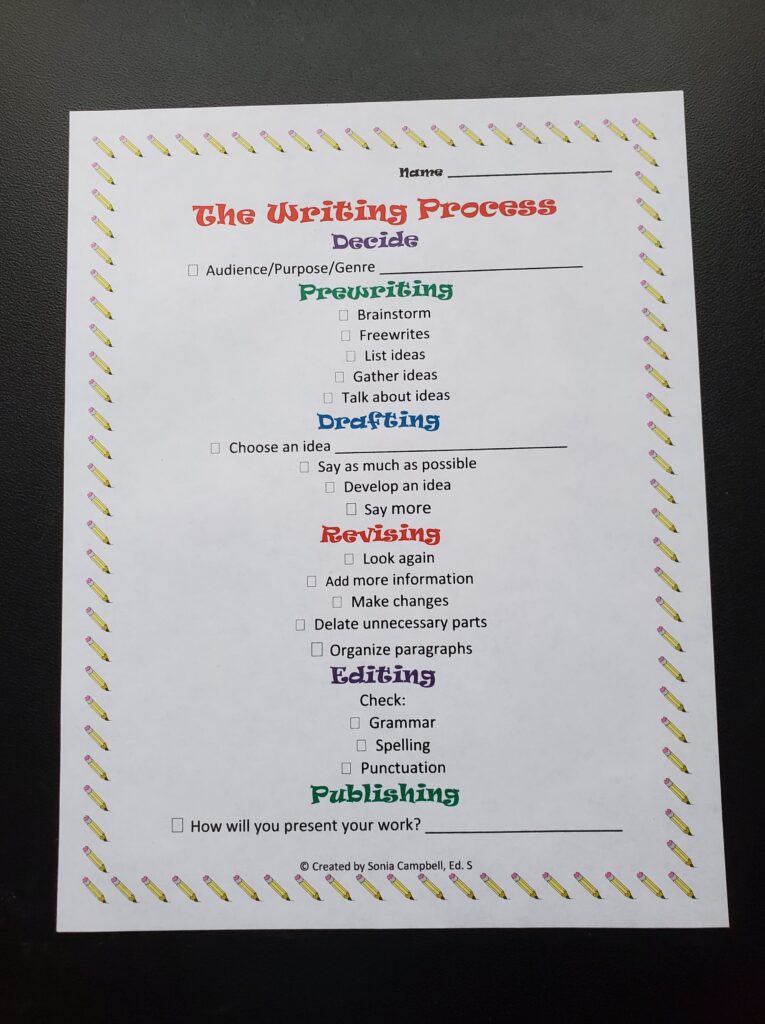
The Writing Process

I have found that it is helpful to introduce the writing process to students at the start of the school year and/or before we jump into focused writing. When I do this it helps the students become familiar with the writing process vocabulary, see the big picture of how we will approach writing, and understand the writing process is a guide to help us tackle our writing.

Prewriting

Before students can begin writing they need to have something to write about. This step is intended to help them find an interesting topic through brainstorming, freewriting, generating ideas, listing ideas, talking to others, etc. Students are more likely to take ownership of their writing when they have chosen their own topics.

Drafting

Once an idea has been chosen, I suggest that the first draft be written in their writer’s notebooks. I remind my students that a writer’s notebook is a place to hold their thinking. The first draft will not be and should not be perfect. It will be a skeleton of an idea that needs to be developed. At this stage, students should aim to have a beginning, middle and end to their writing as this will make a peer conference much more productive. Once the writer has a draft it is time to get feedback from a listener/reader. This is a peer conference time. Students may meet as often as they need to, but the meetings should not take over their writing time, and the meeting must help the writer. If this is not carefully structured students will see this as a time to socialize. I suggest that they meet a maximum of ten minutes and then return to their writing spot. The teacher will also be involved in teacher/student conferences.

Revising

This is the step that students enjoy the least because it requires them going back and taking a very close look at the work they have done so far. Often young writers think that writing is done in one take and they want to jump to publishing. Before publishing, they need to ask themselves some revising questions. For example, Did I write about one idea? Do I need to move sentences/paragraphs around? Do I need to add more details? Do I need to delete parts? Does my writing make sense as a whole? If they have had peer or teacher conferences, they should have a few ideas as to how they can move forward in their writing.

Editing

This is the time for students to focus on checking grammar, punctuation, and spelling. Students can work on their own or with a partner to check their work. For an effective peer conference, you need to give clear guidelines and model expectations. An editing checklist will help to guide conferences and students working independently.

Publishing

For the final step students will publish their writing in an appropriate format. The format will depend on the genre.

Finally, keep in mind that the writing process steps can involve revisiting some steps more than once. As students work through the process, they will see that there are times when they want to revisit a step to make their writing stronger. For example, while students are editing, they might recognize that there is something that they want to go back and revise. This is a normal part of being a writer and I think it shows that the student is placing value on clearly communicating their writing idea.

Keep it going!

Once you have shared the writing process steps with the students be sure to have them on display so your students can refer to them throughout the school year.

Happy Writing!

Sonia

P.S. Below are free downloads of a mini poster of The Writing Process and a Writing Process Checklist that can be used in your classroom. Students can check off and fiil in the blanks on the checklist to help them stay focused and on target as they write.

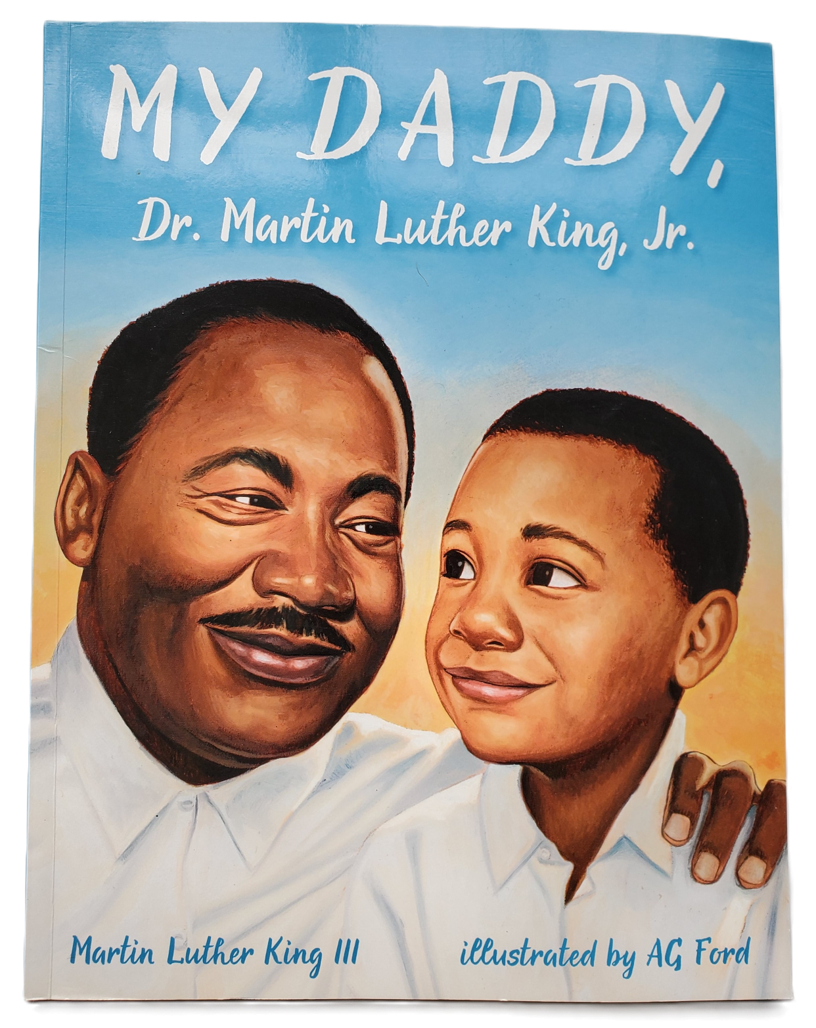
Recommended Read Aloud Picture Book for MLK Day

My Daddy, Dr. Martin Luther King, Jr. by Martin Luther King lll

This picture book narrative is told from the perspective of Martin Luther King, Jr.’s eldest son, Martin Luther King lll. He says, “There have been a lot of books written about my father. But not a whole lot has been written about my dad.” He reflects on the father side of his well-known father. He shares their father and son relationship, and how he felt about his father’s work. Martin Luther King, Jr. died when he was 10 years old.

I think this a great read aloud to share with students in grades 3-5 as it is an opportunity for them to learn about Martin Luther King, Jr from a child’s perspective, his son, Martin Luther King lll. Most likely, students will already have some knowledge about Martin Luther King, Jr. and the work that he did. Usually, they will have heard the information from an adult’s point of view.

Class Discussion

After reading the text, ask students to share any new information that they learned about Martin Luther King, Jr. For example, the kind of games he played with his son, he was not a tall man, and he had the boys burn the toy guns they had received as Christmas presents.

Martin Luther King lll and his sister, “complained” to their parents that they didn’t want to go to the new school.

Can you think of a time when you had to go to a new school? How did you feel? Why?

If you were Martin Luther King lll and his sister having to go to their new school, how would you feel? Why?

I prefer to have a hard copy of the book to share with my students. That way I can use post-its to pinpoint discussion points. If you are unable to get a copy here is a link https://youtu.be/msrEu5tOGMA to the book being read online.

Happy MLK Day,

Sonia